
Your junk food addiction
Junk food is sold as harmless pleasure, when it is really engineered craving. A lifetime of sweetness and crunch; hundreds of kilos of sweets, crisps, and refined sugar, that quietly locks ~440 m² of cropland into constant production each year, keeping fields chemically hostile and mechanically violent so “treats” stay cheap and endless. And the bill isn’t just paid in calories. This indulgence stacks up to around 1.8 million dead lives, mostly insects and soil invertebrates, with the occasional small mammal or bird erased at the margins.
~105,000 insects (mechanical, ≥1 mm share only): — Churned into pulp by maintenance, traffic, and harvest operations.
Insects (pesticides, ≥1 mm share only):
~190,000 flies & midges — Drift and residues sterilise damp edges and field margins.
~140,000 moths & caterpillars — Foliage treated; larvae die mid-growth, mid-metamorphosis.
~80,000 beetles — Ground disturbed and treated; crushed or neurologically shut down.
~35,000 ants & colony insects — Nest networks disrupted; colonies collapse underground.
~19,000 pollinators & “beneficials” — Collateral kills from sprays meant for someone else.
~6,000 aquatic emergent insects — Ditches/edges degraded; breeding windows close.
~120,000 other insects — Small lives erased and never recorded.
Other Invertebrates (mechanical, ≥1 mm share only):
~380,000 earthworms — Split by disturbance; dragged into light; die exposed.
~280,000 springtails (≥1 mm share) — Habitat reset; moisture lost; die off in drying soil.
~80,000 mites (≥1 mm share) — The worked layer becomes a blender.
~46,000 spiders — Cover removed; crushed; starvation follows prey-web collapse.
~8,000 snails & slugs — Crushed, poisoned, or desiccated on exposed ground.
~5,000 millipedes & centipedes — Burrows destroyed; bodies shredded in disturbance.
~7,000 woodlice & isopods — Refugia stripped; crushed or desiccated.
~8,000 other macro-invertebrates — Grubs and soil animals erased as “operations.”
Other Invertebrates (pesticides, ≥1 mm share only):
~25,000 earthworms — Weakened by toxins; many die, soil thins.
~23,000 springtails (≥1 mm share) — Residues disrupt feeding and moulting.
~19,000 mites (≥1 mm share) — Populations crash after exposure.
~24,000 spiders — Secondary poisoning through prey; nervous systems fail.
~22,000 snails & slugs — Impaired movement; dehydration and exposure finish them.
~7,000 millipedes & centipedes — Slow failure after contact.
~8,000 woodlice & isopods — Contact toxicity; die-off follows.
~23,000 other macro-invertebrates — Larvae and predators die after residue exposure.
Including insects and invertebrates in the 0.1 mm to 1 mm size range, would add 16,100,000 lives, mostly comprised of mites and springtails.
Sweets & Chocolates
This is half a tonne of “treats”, 524 kg of sugar-and-fat dopamine, sold as harmless joy while it quietly props up the obesity epidemic and the profit logic of engineered craving.
To supply it, you effectively keep ~420 m² of cropland working every year—mostly for cocoa’s land-hungry yield, a little for sugar—fields run like production lines: ground cleared, plants managed, pests chemically suppressed, and the living skin of the soil treated as expendable. What reaches your mouth is sweetness; what pays the bill is a long, invisible thinning of life.
Over your lifetime, you confectionary addiction eviscerates around 1.7 million lives. This comes to a wet mass of around 400 kg. Think of hot chocolate. For every three scoops of hot chocolate you stir in, picture two scoops of bug-mince swirling through the mug and settling into that last, warm, gritty sludge you have to swallow.
Death toll attributable to your inability for restraint:
~9 small mammals — Refuge stripped; bodies crushed or buried in repeated field passes.
~2 wild birds — Nest sites erased; territories fail when the field is kept hostile.


A breakdown of the death toll attributable to Biscuits & Crisps:
~3,000 insects (mechanical, ≥1 mm share only): — Ground to pulp in cultivation and harvest passes.
Insects (pesticides, ≥1 mm share only):
~7,000 flies & midges — Drift hits margins; the damp edge goes silent.
~5,000 moths & caterpillars — Host plants sprayed/removed; larvae die mid-metamorphosis.
~3,000 beetles — Soil disturbed and treated; crushed or neurologically shut down.
~1,000 ants & colony insects — Nests collapsed by disturbance; colonies fail underground.
~400 pollinators & “beneficials” — Collateral kills; sprayed because they share the air.
~200 aquatic emergent insects — Ditches/edges degraded; breeding windows close.
~4,000 other insects — Nymphs and larvae erased and never noticed.
Other invertebrates (mechanical, ≥1 mm share only):
~11,000 earthworms — Split by cultivation; dragged into light; die exposed.
~8,000 springtails — Habitat reset; desiccation follows disturbance.
~2,500 mites — Soil structure collapses; they die with the microhabitat.
~1,500 spiders — Cover removed; crushed in passes; starvation after prey collapse.
~400 snails & slugs — Crushed or bait-killed; dehydration finishes survivors.
~200 millipedes & centipedes — Burrows destroyed; bodies shredded in soil disturbance.
~400 other macro-invertebrates — Grubs and predators erased as “field operations.”
Other invertebrates (pesticides, ≥1 mm share only):
~1,000 earthworms — Weakened by toxins; many die, soil thins.
~800 springtails — Residues disrupt feeding; populations crash locally.
~700 mites — Residues disrupt feeding; slow die-off in treated soil.
~800 spiders — Secondary poisoning through prey; nervous systems fail.
~1,000 snails & slugs — Contact/baits; movement fails; dehydration follows.
~300 millipedes & centipedes — Chemical pressure kills slow-moving soil predators.
~1000 other macro-invertebrates — Larvae and soil predators die after residue exposure.
Including insects and invertebrates in the 0.1 mm to 1 mm size range, would add 490,000 lives, mostly comprised of mites and springtails.
Biscuits & Crisps
This looks like a snack aisle—dry, harmless, “just carbs”. But over a lifetime it quietly locks about ~14.6 m² of arable cropland into constant rotation every year. Not pasture. Not hedgerows. Pure worked field: soil opened, rolled flat, sprayed, and harvested again and again to turn wheat, sugar, and oil into something you eat in ten seconds.
In this case it’s 649 kg of indulgence; calorie-dense, engineered for craving, a small pillar of the obesity epidemic and the greedy economics of “moreish” food.
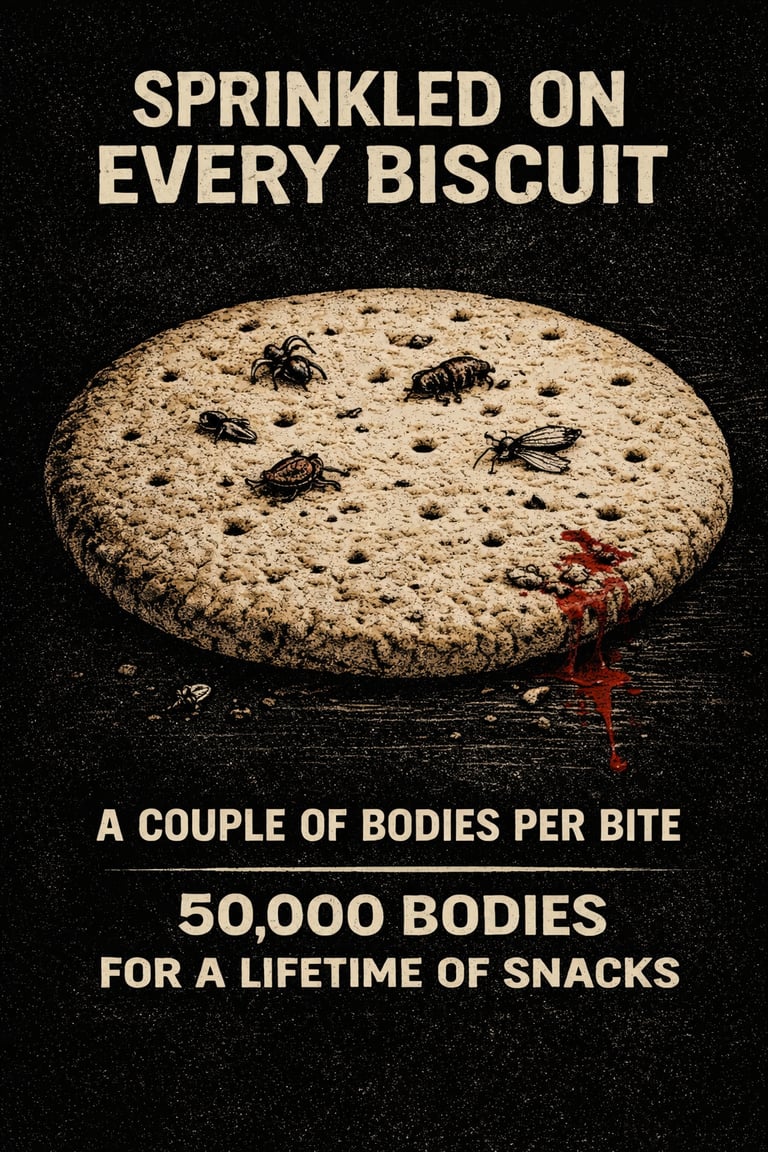
The deaths here aren’t dramatic, they’re routine: bodies crushed in the churn of machinery, then the survivors thinned by chemicals designed to make fields hostile to life. It totals around 50,000 bodies, or about 15 kg of death. Imagine sprinkling a couple of dead bodies onto each biscuit you consume, a spider here, part of an earthworm there. That is the price.
Sugar & Preserves
This is the sweetener layer underneath modern diets: 354 kg of refined sugar-equivalent, spread thinly through tea, cereal, desserts, jams, and “just one more” snacks. The land footprint is deceptively small—only about ~3.7 m² of cropland held in production every year—but it’s sugar beet, a high-disturbance row crop: soil cultivated hard, weeds suppressed chemically, and the harvest itself is a violent extraction that drags roots and tonnes of soil through machinery. Tiny footprint; high brutality per square metre. Over your lifetime, this relates to around 25,000 deaths, or about 10 kg of life.
Breakdown of death toll attributable to Sugar & Preserves:
~2,000 insects (mechanical, ≥1 mm share only): Mulched by cultivation; bodies broken in soil and traffic passes.
Insects (pesticides, ≥1 mm share only):
~2,000 flies & midges — Drift sterilises damp margins; breeding habitat collapses.
~1,000 moths & caterpillars — Leaves treated; larvae die mid-growth.
~700 beetles — Soil disturbed and treated; crushed or neurologically shut down.
~300 ants & colony insects — Nest networks disrupted; colonies fail underground.
~200 pollinators & “beneficials” — Collateral kills from broad-spectrum controls.
~100 aquatic emergent insects — Ditches/edges degraded; breeding windows close.
~1,000 other insects — Small lives erased and never counted.
Other invertebrates (mechanical, ≥1 mm share only):
~8,000 earthworms — Split by disturbance; dragged into light; die exposed.
~6,000 springtails — Habitat reset; moisture lost; die off in drying soil.
~2,000 mites — Micro-refugia crushed; exposed and lost.
~900 spiders — Cover removed; crushed; starvation after prey collapse.
~200 snails & slugs — Crushed, bait-killed, or desiccated on exposed ground.
~100 millipedes & centipedes — Burrows destroyed; bodies shredded in disturbance.
~300 other macro-invertebrates — Grubs and soil animals erased as “operations.”
Other invertebrates (pesticides, ≥1 mm share only):
~300 earthworms — Weakened by toxins; many die, soil thins.
~200 springtails — Populations crash after residue exposure.
~300 mites — Residues disrupt feeding; recovery fails.
~200 spiders — Secondary poisoning through prey; nervous systems fail.
~200 snails & slugs — Baits/residues kill; movement fails; dehydration finishes them.
~100 millipedes & centipedes — Contact exposure; slow recovery.
~300 other macro-invertebrates — Larvae and predators die after residue exposure.
Including insects and invertebrates in the 0.1 mm to 1 mm size range, would add 350,000 lives, mostly comprised of mites and springtails.