
Corpses you gorge on
This is the butcher’s bill of bodies. Individual lives converted into a routine you barely register.
Every meal hides an enormous and largely invisible body count. The food on your plate is not just the cow, pig, chicken or fish you knowingly consume. It also represents the countless smaller lives destroyed in the process of producing it: animals killed during harvesting, creatures displaced or crushed by agricultural machinery, wildlife poisoned by pesticides, and entire ecosystems cleared to grow feed crops.
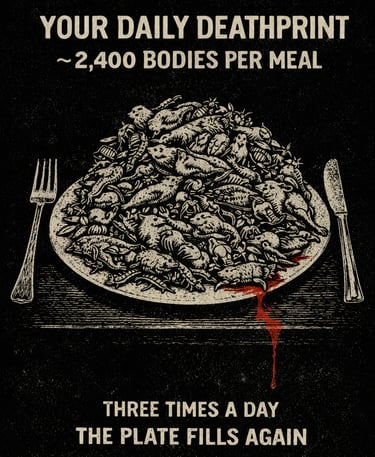
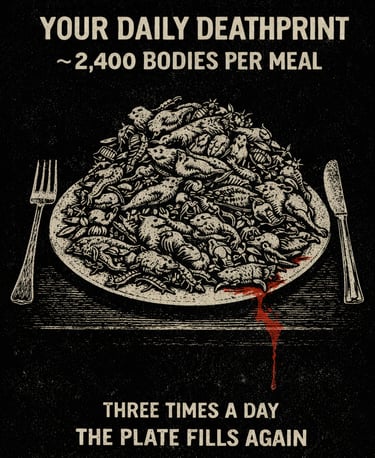
When these direct and indirect deaths are combined, the toll becomes staggering. If your personal deathprint were divided into three meals a day for the duration of your life, each plate would carry roughly 2,400 dead bodies — a hidden graveyard beneath the illusion of an ordinary meal.
Direct killing
~4 cows are herded into a steel chutes so narrow they can’t turn, then a bolt is fired through each of their skulls; they’re shackled, hoisted, their throats slit open to drain them, their hides peeled away; all done on their second birthday, in bodies meant to see two decades.
~20 pigs are driven with prods into a chamber that fills with gas until they panic, gasp, and collapse, or they’re stunned and stuck while the heart still beats; it happens at six months, when pigs can naturally live twelve years.
~17 sheep are tipped onto their backs, restrained, stunned, and cut at the throat so blood pours out in pulses; most are killed as lambs; before their first birthday, when they could have had a decade ahead of them.
~1,950 chickens are bred to reach slaughter weight in ~6 weeks. A body built too fast for their skeleton, many are limping, collapsing, or dying in the ammonia haze of crowded sheds. Either way, they’re grabbed by their legs, shackled upside down, and sent through electrified water as their throats are cut.
~12 ducks are hatched into an industry that selects for unnaturally rapid growth, kept on wet litter that burns skin and feet, crowded under artificial light; then they’re caught by the neck or legs, hung upside down, and fed into a line where blades miss often enough that some reach the scalding tank alive.
~10 turkeys are engineered into oversized bodies (breasts too heavy, legs strained, hearts and lungs struggling to keep up) living under constant glare in packed barns; then they’re stunned, hung, and bled out on moving hooks while still warm.
~43 salmon spend their lives in sea cages where parasites spread and wounds fester, packed tight enough that disease moves faster than they can swim; then they’re pumped out by hose, stunned or not, and begin dying the moment water is replaced with air.
~4 trout are raised in raceways and tanks, water churned with waste and stress, then crowded into nets; they’re hauled out, gills flaring in empty air, and bleed out after their gill arches are cut—panic turning into silence.
~4 tuna are hooked at speed in the open ocean, dragged until exhaustion turns to compliance, then hauled aboard to be spiked through the brain or left to bleed out—giant bodies reduced to loins while the deck still steams with heat.
~133 cod are swept up from cold depths in trawl nets, their swim bladders and organs tearing as pressure changes; they hit the deck and die slowly in air—mouths opening and closing on nothing.
~67 haddock are funnelled into nets that scrape skin and slam bodies together, then shoveled into ice; the death is not a single act, but compression, suffocation, and cold.
~2,390 mackerel are hauled up in writhing slabs of silver, packed so tightly they can’t flex; they die layered on each other, gills pinned shut by the weight of the school.
~1,200 herring suffocate by the ton in holds below deck, bodies collapsing into a single, shifting mass—life ending as a bulk material, not an individual story.
~319 sardines are surrounded by a wall of net, driven into panic-tight circles, then lifted out in a dripping heap; they die crushed and drying, scales turning dull in minutes.
~80 anchovies vanish as bycatch—swept up, bruised, and dumped with everything else; a life so small it’s treated as “volume,” not a creature.
~10,500 prawns are raised by the billions, often in warm, oxygen-poor ponds where antibiotics and chemicals prop up survival; then they’re tipped into ice slush or boiling water—each one a tiny animal whose body still tries to escape.
~122 crabs are pulled up from traps and piled into crates where legs snap and claws are banded; many are cooked alive—steam creeping into every joint while the animal still moves.
~11 lobsters are stored alive on rubber bands and cold darkness, then lowered into boiling water or steamed intact—muscles convulsing as heat drives through nerve tissue.
~3,760 scallops are scraped off the seabed by dredges that grind the ocean floor into rubble; many are crushed outright, and the rest die slowly in air as living muscle dries and the world turns hard.
~1,580 mussels are stripped from ropes and rocks in heavy clumps, exposed to sun and air until they gape; then heat forces their shells open while they’re still alive inside.
~240 oysters are torn from reefs that take years to form, kept alive until a knife pries them open; their adductor muscle is severed, organs cut free, and the animal is eaten as it dies.
~119 squid are hauled up and dumped into air, skin flashing as neurons misfire; they suffocate while their bodies still try to jet, then are gutted into rings and “calamari.”
~5 octopuses are pulled from their dens and dragged into air, where a mind built for curiosity and puzzle-solving is reduced to panic; they’re often killed by blunt blows, suffocation, or being cut apart; each one is a thinking individual, not a product.
Cow Flesh
To keep a beef & veal habit running, year after year, you effectively hold about ~2,190 m² of land in food-production mode every year: roughly ~2,060 m² of pasture/grassland kept grazed, fertilised, and chemically managed, plus ~140 m² of cropland repeatedly drilled, sprayed, and harvested to grow feed. That split matters, because pasture kills quietly (mowing, trampling, slurry, parasite-drug residues that poison dung life), while cropland kills mechanically and chemically (tillage/harvest trauma + pesticides).
The incidental deaths associated with eating 4 cows over your lifetime is staggering; around 1.9 tonnes of insects and invertebrates, ~6.900,000 lives. For every 150g portion of cow that you eat, don't forget to enjoy a side of roughly 260g of worms, mites, spiders, slugs, and insects. Dig in.
Incidental deaths include:
Insects (≥1 mm share only):
~410,000 flies & midges — thinned by drift/residue near edges and repeated disturbance.
~630,000 moths & caterpillars — host plants treated or removed; larvae die mid-transformation.
~340,000 beetles — crushed in field operations and suppressed by residues.
~90,000 beetle larvae & grubs — soil cohorts shredded when ground is disturbed.
~55,000 ants & colony insects — colonies fail where margins are disturbed & simplified.
~21,000 pollinators & “beneficials” — collateral kills in the spray-shadow of production.
~5,000 aquatic emergent insects — wet edges degraded; breeding windows close.
~340,000 other insects — nymphs, larvae, and the uncounted remainder erased as background cost.
~2,100,000 springtails — larger-bodied share repeatedly reset.
Other invertebrates (≥1 mm share only):
~1,600,000 earthworms — split, exposed, and exhausted by disturbance and hostile chemistry.
~510,000 mites — tiny soil animals; populations crash after repeated disruption.
~560,000 spiders — predators of the field; cover collapses and prey-webs vanish.
~102,000 snails & slugs — crushed, bait-killed, or desiccated on stripped ground and margins.
~44,000 millipedes & centipedes — refugia removed; bodies shredded or left to dry.
~80,000 woodlice & isopods — moisture habitat lost; die in disturbed, drying ground.
~75,000 other macro-invertebrates — grubs, predators, and soil animals erased as “operations.”
Including insects and invertebrates in the 0.1 mm to 1 mm size range, would add ~48,000,000 lives, mostly comprised of mites and springtails.
Pig Flesh
Every year, to maintain your pig-eating habit, you keep ~244 m² of arable cropland locked into pig-feed production—wheat/barley plus protein meals—run as an industrial cycle of ploughing, drilling, spraying, and harvesting. Over an 80-year life that feed system supports ~1,150 kg of edible pork, and the slaughterhouse finish is ~20 pigs. But the real deathprint is upstream: machines that mulch living bodies in the soil, and pesticides that collapse insect and soil-animal communities across those fields.
The incidental deaths associated with eating ~20 pigs over your lifetime is even more staggering than cows; around 200 kg of insects and invertebrates. For every 150g portion of pig that you eat, you side-helping of 24g of worms, mites, spiders, slugs, and insects. Hope you're hungry.
Incidental death toll attributable to your consumption of pig flesh reaches ~1,000,000 over your lifetime:
~5 small mammals — (field mice, shrews) chopped by harvesters or buried alive when soil is turned.
~1 wild bird — Nests shredded; cover removed; exposure and hunger finish them.
~1 amphibian — Sprayed margins and drained damp ground; skin-breathers fail fast.
Insects (≥1 mm share only):
~130,000 flies & midges — Sprayed or mulched; moisture-web collapses around them.
~95,000 moths & caterpillars — Host plants removed; larvae die mid-metamorphosis.
~60,000 beetles — Poisoned by residues or crushed in repeated field passes.
~22,000 ants & colony insects — Nests collapsed by disturbance; colonies fail underground.
~11,000 pollinators & “beneficials” — Collateral kills from broad-spectrum sprays and drift.
~4,000 aquatic emergent insects — Ditches/edges degraded; adults die without breeding.
~80,000 other insects — Nymphs and larvae wiped out as “pests” or collateral.
Invertebrates (≥1 mm share only):
~270,000 earthworms — Torn by ploughs; soil turned into a lethal blender.
~198,000 springtails — tiny soil decomposers; huge counts, wiped out in repeated resets.
~65,000 mites — tiny soil animals; populations crash after repeated disruption.
~42,000 spiders — Cover stripped; prey collapses; sprayed margins become dead zones.
~18,000 snails & slugs — Crushed, poisoned, or desiccated on exposed ground.
~8,000 millipedes & centipedes — Burrows destroyed; bodies shredded in tillage.
~9,000 woodlice & isopods — Habitat reset; die in drying soil and chemical fallout.
~19,000 other macro-invertebrates — Grubs, larvae, and soil animals erased as “disturbance.”
Including insects and invertebrates in the 0.1 mm to 1 mm size range, would add ~10,500,000 lives, mostly comprised of mites and springtails.
Bird Flesh
Every year, to keep eating birds, you lock ~204 m² of arable cropland into growing feed—cereals plus oilseeds/soy—run as an industrial loop of cultivation, drilling, spraying, and harvest. Over your lifetime that becomes ~1,816 kg of bird flesh, and it kills two ways: in sheds and in fields. ~1,950 chickens have their throats slit, ~12 ducks are drawn through a scalding tank (some still alive), and ~10 turkeys are bled out on moving hooks. Behind that, the feed fields do the quieter work: machinery and chemistry reset the land in pulses, thinning soil and edge communities again and again.
The incidental deaths associated with eating birds over your lifetime is even more staggering than cows; around 280 kg of insects and invertebrates. When you serve up that roast chicken at the dinner table, don't forget the ~250 g side of worms, flies, spiders, slugs, and insects. The kids will love it.
Your lifetime consumption of bird flesh leads to ~910,000 incidental deaths. That's the equivalent of crushing a bug under your thumb every 30 minutes for the entirety of your waking life.
~4 small mammals — (voles, young rabbits) harvesters and tillage turn cover into blades and burial.
~1 wild bird — Nesting cover removed; chicks fail when food and shelter vanish overnight.
Insects (≥1 mm share only):
~110,000 flies & midges — drift and residue thin the damp edge; breeding habitat collapses.
~83,000 moths & caterpillars — sprayed foliage cuts life cycles mid-transformation.
~50,000 beetles (adult) — disturbed and poisoned; crushed in repeated passes.
~18,000 ants & colony insects — nests fail where margins are repeatedly disturbed and
simplified.
~10,000 pollinators & “beneficials” — collateral damage in the spray-shadow of food production.
~3,000 aquatic emergent insects — ditches and wet edges degraded; adults die without breeding.
~68,000 other insects — nymphs, larvae, and the uncounted remainder erased as background cost.
Other invertebrates (≥1 mm share only):
~241,000 earthworms — split, exposed, and exhausted by soil disturbance and hostile chemistry.
~176,000 springtails — the tiny workforce of soil, wiped out in repeated resets.
~58,000 mites — populations crash after disturbance and residue exposure.
~37,000 spiders — predators of the field; cover collapses and prey-webs vanish.
~16,000 snails & slugs — crushed, bait-killed, or desiccated as the ground is stripped bare.
~14,000 beetle larvae & grubs — pupation sites destroyed; bodies chopped and buried.
~8,000 woodlice & isopods — moisture habitat lost; die in drying, disturbed soil.
~20,000 other macro-invertebrates — centipedes, millipedes, lacewing larvae: erased as “disturbance.”
Including insects and invertebrates in the 0.1 mm to 1 mm size range, would add ~9,300,000 lives, mostly comprised of mites and springtails.
Fish & Sea Creatures
To sustain your habit of consuming sea creatures, about 7.5 kg per year, you don’t just rob them of their lives. Your demand “processes” the sea physically: roughly ~810 m² of seabed swept per year by bottom-contact gear (trawls / dredges), plus about ~20 m² of cropland per year indirectly (soy / wheat / rapeseed grown for aquaculture feed, plus fishmeal/fish oil made from forage fish). Add bycatch / discards and a small allocation for ghost gear, and your lifetime seafood turns into a ledger dominated by benthic invertebrates; animals killed because the seafloor gets treated like a field.
Seafood hides the damage better because it happens underwater — but it isn’t cleaner. Your lifetime “normal” seafood habit drives roughly 3 tonnes of invertebrate death, dominated by what gets shredded, crushed, or buried when sea beds are swept. For every 150 g portion of seafood, you’re carrying a hefty side-helping of about ~800 g of ocean and field invertebrates wiped out to make it possible. Enjoy the taste of the seafloor.
Incidental death toll attributable to your lifetime consumption of sea creatures:
~4,700 forage fish (fishmeal/fish oil) — Ground into feed so farmed seafood can exist.
~300 fish (bycatch/discards) — Caught unintentionally; dumped or released injured; many still die.
~7 fish (extra farm mortality, salmon) — Die in cages before harvest; losses allocated per eaten salmon.
~12 crustaceans (bycatch/discards) — Swept up with target catch; crushed, discarded, or die later.
Cropland invertebrates (≥1 mm share only):
~24,000 earthworms — killed by cultivation/harvest + low-level pesticide pathway (≥1 mm scope doesn’t change worms).
~13,000 springtails — the “big-enough-to-count” fraction; micro-collembola excluded.
~11,000 flies & midges — Sprayed or drift-killed; moisture edges collapse into dead strips.
~6,000 moths & caterpillars — Host plants sprayed/removed; larvae die mid-transformation.
~5,000 beetles — Soil disturbed and poisoned; crushed or neurologically shut down.
~3,000 spiders — cover removed; crushed; prey web collapses.
~3,000 mites — micro-mites excluded.
~3,000 other macro-invertebrates (≥1 mm) — grubs/larvae mix.
~2,000 ants & colony insects — Nests broken by disturbance; colonies fail underground.
~2,000 snails & slugs — crushed/poisoned/desiccated.
~1,500 woodlice & isopods — moisture refugia lost.
~1,000 pollinators & “beneficials” — Collateral kills from broad-spectrum sprays and drift.
~1,000 millipedes & centipedes — burrows destroyed; bodies shredded.
~500 aquatic emergent insects — Ditches/edges degraded; adults die without breeding.
~9,000 other insects — Larvae/nymphs erased as “pests” or collateral.
Seafloor invertebrates (trawl/dredge disruption; ≥1 mm macrobenthos):
~1,700,000 benthic worms (polychaetes) — Sediment churned; soft bodies shredded in the pass.
~670,000 small bivalves & gastropods — Shell-bearers smashed; buried alive under disturbed seabed.
~490,000 benthic crustaceans — Crushed in gear contact; limbs torn; die exposed.
~21,000 echinoderms (starfish/urchins etc.) — Torn up and damaged; many die after injury.
~205,000 sessile filter-feeders (sponges/bryozoans/hydroids) — Ripped from substrate; destroyed as “seafloor roughness.”
~110,000 other benthos — Mixed bottom life pulverised; counted only as “biomass loss.”
Including animals in the 0.1–1 mm size range would add ~20,000,000 lives (very rough; order-of-magnitude), dominated by seafloor meiofauna; mostly free-living nematodes and small copepods/ostracods.