Animal products you eat
Milk, cheese, and eggs look bloodless from the checkout, but they still cash out in forced pregnancies, shredded male chicks, spent hens, slaughtered cows and calves, and the quiet mass death of fields kept barren so you can keep eating them.
Indirect Killing
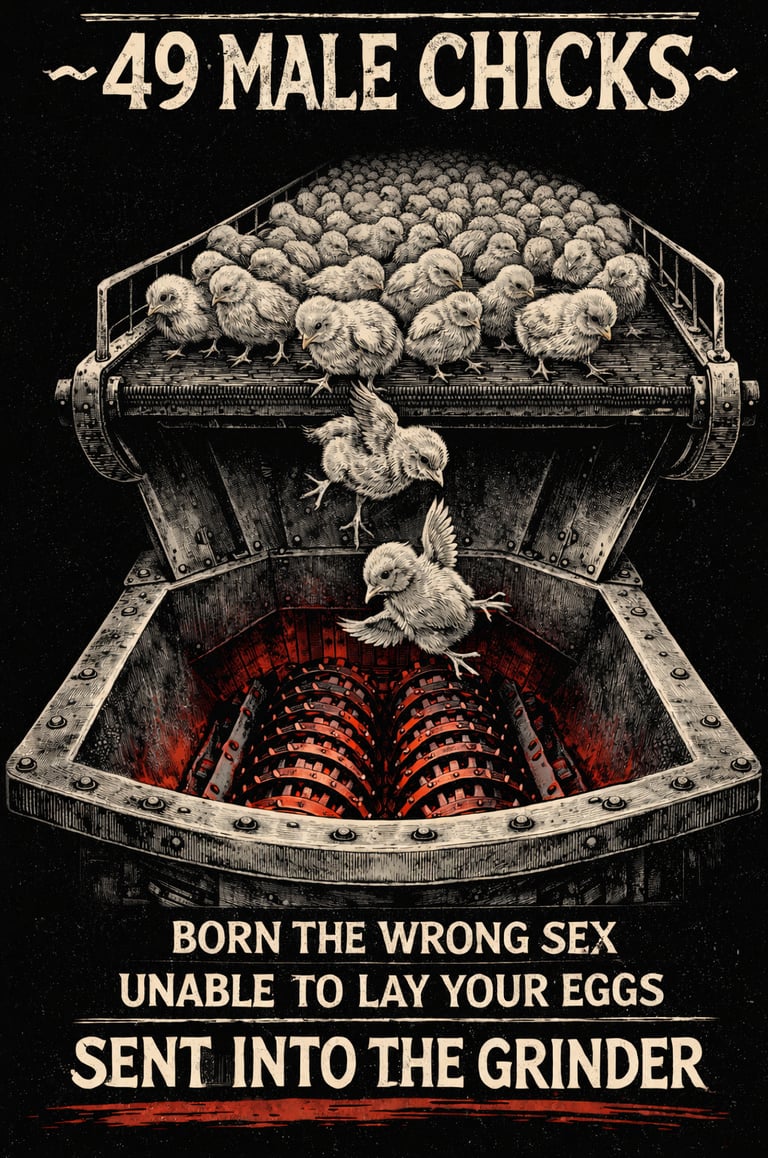
~49 male chicks hatch into bright light, are sexed in seconds, and (because they can’t lay eggs) are sent down a chute to be macerated alive the same day their eyes first open.
~44 hens spend their lives laying far beyond what their bodies were built for, bones thinning and organs strained; when production drops, they’re caught, crated, and killed. They're spent machinery disposed of to keep eggs cheap.
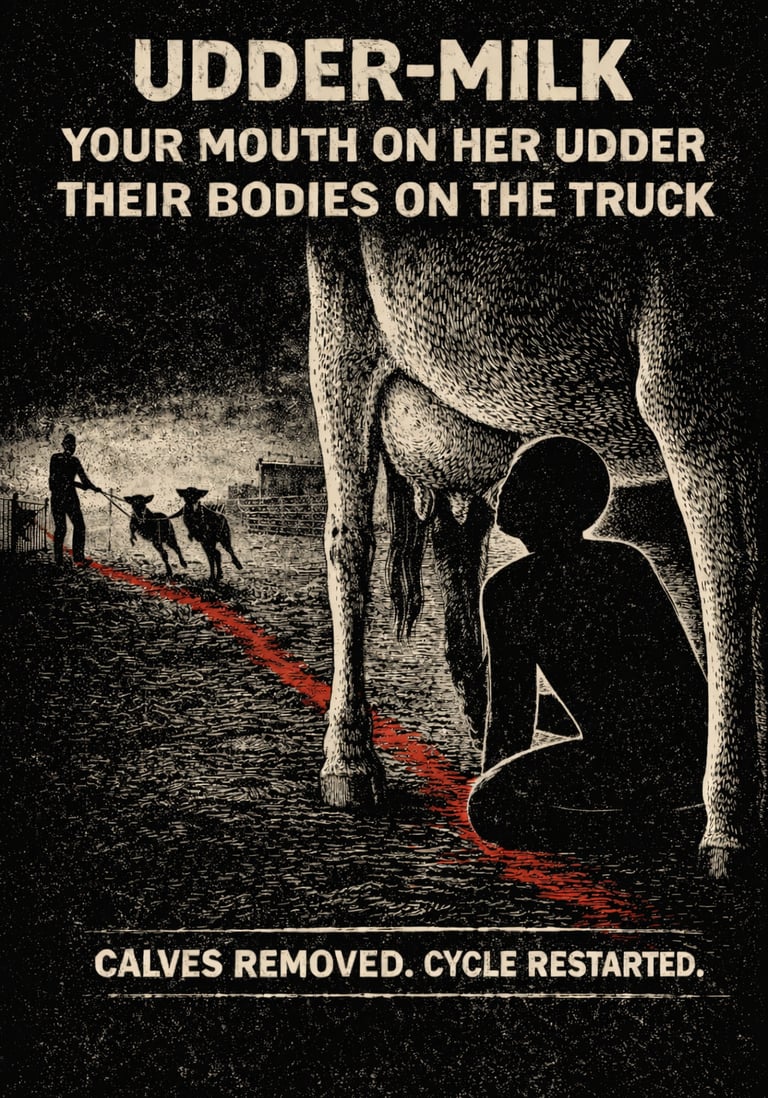
~1 dairy cow is made to give milk only by repeated pregnancy. Her calves are taken away so the milk goes to you. After years of milking, infections, exhaustion, and declining yield, she’s loaded onto a truck and slaughtered when she’s no longer profitable.
~2 calves are born as collateral for your habit of drinking udder-milk; they are pulled from their mothers within days, the calling and searching ending in empty stalls; the males and surplus females are sold off, confined, and killed early so the cycle can restart.
Incidental death toll attributable to you suckling at a cow's udder:
~6 small mammals — (field mice, shrews) mown, crushed, or exposed when grass is cut and fields reset.
~1 wild birds — Nests and cover destroyed; starvation and predation finish the survivors.
Insects & invertebrates (≥1 mm share only):
~175,000 flies & midges — knocked down by field chemistry and edge-habitat collapse.
~160,000 moths & caterpillars — host plants treated/removed; larvae die mid-cycle.
~90,000 beetles (incl. ground/dung-associated) — disturbed, poisoned, or crushed in field operations.
~25,000 ants & colony insects — nest networks broken; colonies fail underground.
~8,000 pollinators & “beneficials” — collateral deaths in the blast radius of pest control.
~3,000 aquatic emergent insects — ditch/edge systems degraded; breeding windows close.
~115,000 other insects — nymphs/larvae and the uncounted remainder erased as background cost.
Soil and margin invertebrates (≥1 mm share only):
~940,000 earthworms — cut, exposed, weakened, and lost as the soil is repeatedly reset.
~120,000 mites — populations crash under disturbance and residues.
~370,000 springtails — soil surface communities repeatedly wiped back.
~120,000 spiders — cover stripped; prey webs collapse; secondary exposure finishes many.
~28,000 snails & slugs — crushed, poisoned, or desiccated on exposed ground.
~11,000 millipedes & centipedes — burrows destroyed; bodies shredded in disturbance.
~14,000 woodlice & isopods — moisture habitat lost; die in drying, disturbed ground.
~12,000 beetle larvae & grubs — pupation sites destroyed; chopped/buried by fieldwork.
~12,000 other macro-invertebrates — larvae, predators, and soil animals erased as “operations.
Including insects and invertebrates in the 0.1 mm to 1 mm size range, would add 19,000,000 lives, mostly comprised of mites and springtails.
Udder-Milk
Every year, to keep drinking udder-milk, you alone lock ~856 m² of farmland into serving you; mostly grassland kept cropped and reset by grazing and mowing, plus a smaller share of arable feed grown through cultivation and sprays. And it kills two ways: in sheds and in fields. ~1 dairy cow is made to produce milk only by repeated pregnancy; her calf is taken so the milk goes to you, and after years of milking, infections, exhaustion, and declining yield she’s loaded onto a truck and slaughtered the moment she stops paying. ~2 calves are born as collateral for your habit—dragged away within days, the calling and searching ending in empty stalls—then sold, confined, and killed early so the cycle can restart. Imagine if it were breastmilk, and you were condemning a woman and two babies to a tortured existence and early death. All because you want to gorge on her milk.
Behind this, the land machine does the quieter work: mowers and harvesters mince field life, and pesticides shut down nervous systems, so your udder-milk habit can be serviced cheaply. That cost is ~2,200,000 lives; ~2.5 tonnes of mostly insects and invertebrates. So for every 300 ml glass of milk, you’re effectively chasing it down with 100 g smoothie of worms, flies, spiders, slugs, and insects. Cheers. This seemingly benign and bizarre habit is one of the most devastating things you do to the environment.
To continue enjoying cheese, you need to sign off on the execution of these creatures:
~42 wild small mammals — (voles, field mice, rats, young rabbits, shrews) mown, crushed, or exposed when grass is cut and fields reset.
~8 wild birds — Nests and cover shredded; chicks fail when the field becomes bare.
~39 amphibians — Cut or desiccated when damp refuges are sliced into stubble.
~17 reptiles — Basking cover removed; crushed or killed by exposure on open ground.
Insects (≥1 mm share only):
~120,000 flies & midges — Cut-cycle mortality + drift/residues; margins thin out after sprays.
~110,000 moths & caterpillars — Host plants removed; larvae die mid-transformation.
~58,000 beetles — Soil and litter disturbed; crushed in passes; residues finish survivors.
~15,000 ants & colony insects — Nest structure disrupted; foragers and brood collapse.
~7,000 pollinators & “beneficials” — Collateral kills; hit by broad-spectrum chemistry.
~2,000 aquatic emergent insects — Edge habitats degrade; adults die without breeding.
~76,000 other insects — Nymphs/larvae erased as “pests” or collateral.
Other invertebrates (≥1 mm share only):
~730,000 earthworms — Split by disturbance; exposed to sun; die or are eaten.
~64,000 mites — Larger-bodied share only; knocked back by tillage + residues.
~205,000 springtails — Larger-bodied share only; repeatedly reset by disturbance.
~73,000 spiders — Cover removed; prey collapses; sprayed edges become dead zones.
~16,000 snails & slugs — Crushed, poisoned, or desiccated on exposed soil.
~6,000 millipedes & centipedes — Refugia stripped; crushed or left to dry out.
~8,000 woodlice & isopods — Moist cover removed; machinery + exposure kills.
~14,000 other macro-invertebrates — Grubs and soil predators erased by "field operations."
Including insects and invertebrates in the 0.1 mm to 1 mm size range, would add 10,500,000 lives, mostly comprised of mites and springtails.
Cheese
To keep your lifetime cheese habit supplied (about 520 kg) you quietly pin ~571 m² of farmland to your appetite every single year. Mostly it is grass and silage: living carpets grown up, then shaved back to nothing, grown up again, shaved back again — the same ground “reset” on a loop so milk can be forced out cheaply. A smaller slice is arable feed cropland, ripped open, drilled, sprayed, harvested, and rolled flat — the sterile side-channel that keeps the dairy machine efficient.
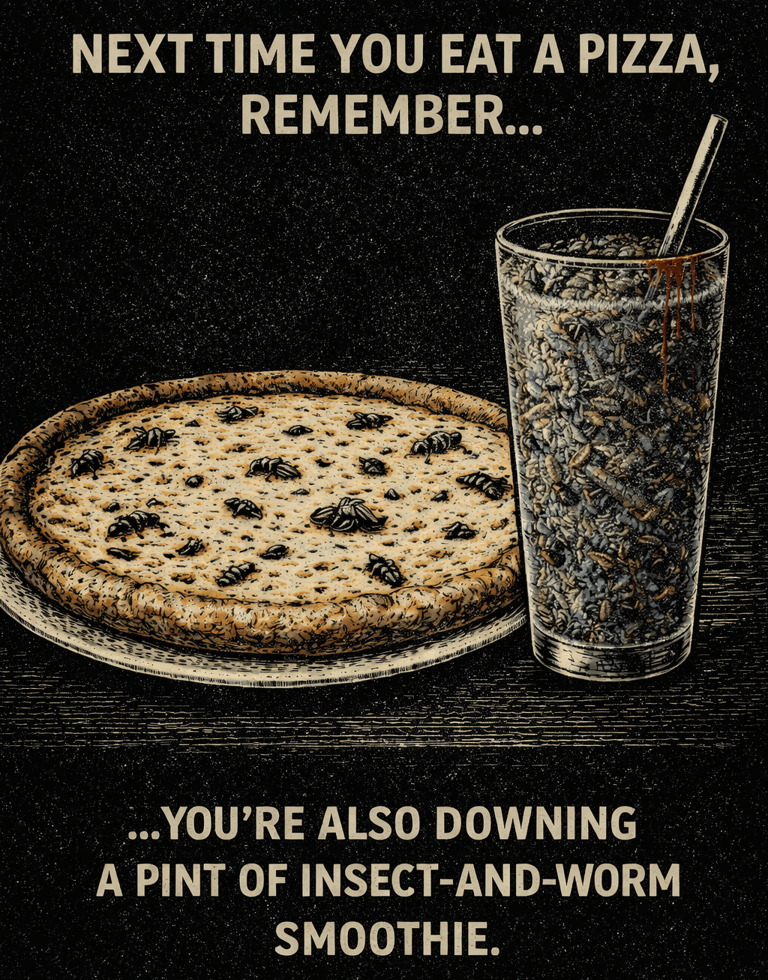
Mowers and cutters mince field life, and the cropland share adds the chemical layer — nervous systems silenced so the feed grows clean and cheap. Counting only insects & invertebrates ≥1 mm, the invisible bill for your cheese is about ~1.5 million lives. That's roughly ~1.5 tonnes of crushed and minced bodies. The next time you eat a pizza, remember you're also downing nearly a pint of insect-and-worm smoothie.
Insects (pesticides, ≥1 mm share only):
~12,000 flies & midges — Drift hits margins; the wet edge goes quiet.
~8,000 moths & caterpillars — Leaves poisoned; larvae die mid-metamorphosis.
~5,000 beetles — Soil disturbed and treated; crushed or neurologically shut down.
~2,000 ants & colony insects — Nest networks collapsed; colonies fail underground.
~1,000 pollinators & “beneficials” — Collateral kills; sprayed because they share the air.
~500 aquatic emergent insects — Ditches degraded; breeding windows close.
~7,000 other insects — Small lives erased and never noticed.
Other invertebrates (mechanical, ≥1 mm share only):
~25,000 earthworms — Split by cultivation; dragged into light; die exposed.
~18,000 springtails — Habitat reset; desiccation follows disturbance.
~5,000 mites — Soil micro-predators/seed feeders wiped in disturbance pulses.
~3,000 spiders — Cover removed; crushed in passes; starvation after prey collapse.
~500 snails & slugs — Crushed or bait-killed; dehydration finishes survivors.
~400 woodlice & isopods — Cover/moisture refuges stripped; crushed and exposed.
~300 millipedes & centipedes — Burrows destroyed; bodies shredded in soil disturbance.
~500 other macro-invertebrates — Grubs and predators erased as “field operations.”
Other invertebrates (pesticides, ≥1 mm share only):
~2,000 earthworms — Weakened by toxins; many die, soil thins.
~1,500 springtails — Residue exposure + soil drying effects.
~1,000 mites — Contact + prey-mediated toxicity.
~1,500 spiders — Secondary poisoning through prey; nervous systems fail.
~1,500 snails & slugs — Chemical contact impairs movement; they dry out.
~500 millipedes & centipedes — Residue exposure in litter/soil interface.
~500 woodlice & isopods — Contact toxicity in damp refugia.
~1,500 other macro-invertebrates — Larvae and soil predators die after residue exposure.
Including insects and invertebrates in the 0.1 mm to 1 mm size range, would add 1,010,000 lives, mostly comprised of mites and springtails.
Eggs
An egg is a hen’s period; a reproductive package her body is pushed to produce on an industrial schedule. Over your lifetime you will consume ~8,320 eggs, that means 8,320 extracted periods for you to slurp down. And it comes with a quiet, built-in killing floor: ~49 male chicks are sexed at hatch and tossed into a meat grinder the day their eyes open for the first time (because they'll never lay and aren't engineered to be profitable meat). And ~44 laying hens are worked until their output drops, then culled and replaced like worn parts.
To keep that machine running you also hold ~25.5 m² of cropland every year, growing feed in fields repeatedly ripped open, rolled flat, sprayed, and harvested; where you drive roughly ~105,000 incidental field deaths (≥1 mm insects and invertebrates. For every carton of twelve eggs you buy, there is a “thirteenth egg” worth of about 150 crushed and minced bodies, together weighing roughly 40 grams. Would you like it poached or fried?
This is a breakdown of the the incidental deaths you are responsible for, to continue your habit of slurping down chicken periods:
~1 small mammal — (field mice, shrews) burrows ripped open; killed by blades, tyres, and soil burial.
~7,000 insects (mechanical, ≥1 mm share only): — Ground to pulp in cultivation and harvest passes.