
Habitat Destruction
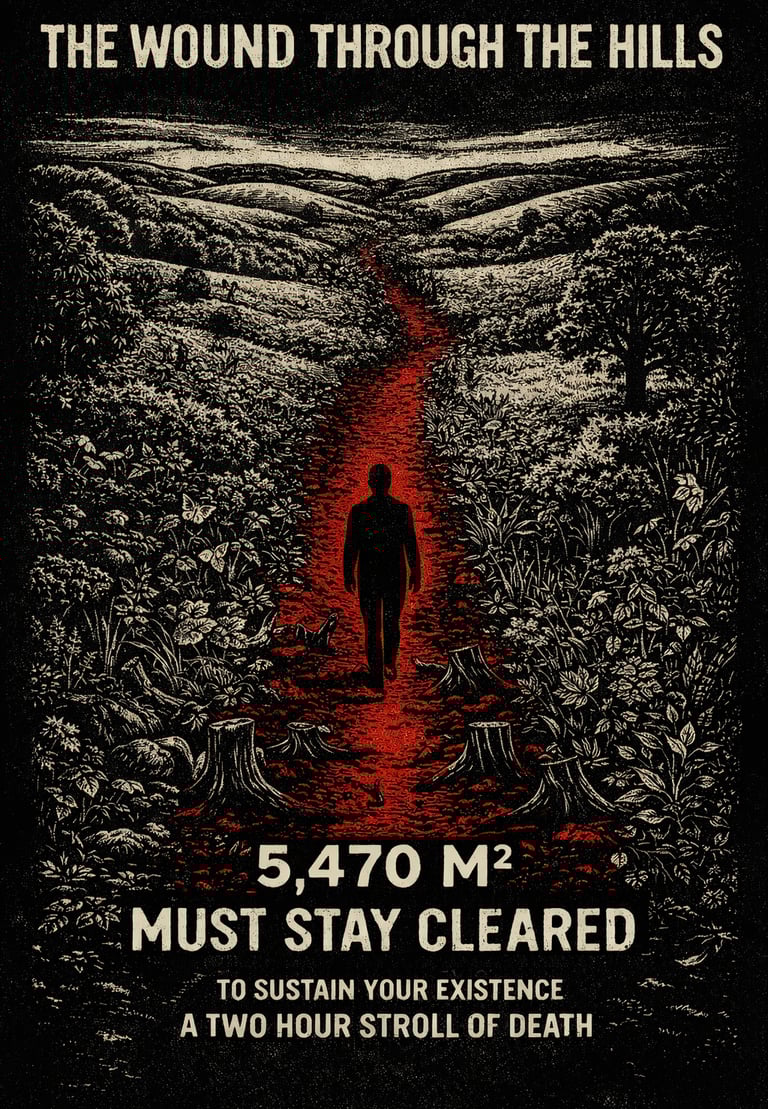
Think back to the last time you took a slow stroll through real wilderness; somewhere that felt alive. Now imagine walking that same kind of walk for 90 minutes, except every single square metre your feet touch is destroyed and repurposed: the living ground turned into ~5,470 m² of monocultured desert or tarmac, as if the world is being switched off behind you one step at a time. And you do it every day. You maintain that strip as a kept wound. Every day you stamp out anything that tries to take root, nest, crawl, or grow back into the path of destruction that keeps you alive.
~3,800 m² of farmland (cropland + grazing) is worked to feed you, continuously.
~1,400 m² of forest is held in a managed “production” state to supply timber, paper, packaging, furniture, and building materials.
~200 m² of built land (homes, shops, industry, services) exists on your behalf, continuously.
~70 m² of roads and their “shadow” (verges, margins, fragmented edges) sit around you like a grid of permanent disturbance.
Even with pesticides and harvest deaths removed, the toll continues:
~5 small mammals die when cover is cleared and refuge becomes open ground—exposed, crushed, or simply removed from the food web.
~2 birds die when nests and territories are shredded and fragmented—often not instantly, but by the slow failure that follows.
~2 amphibians die as wet edges are drained or hardened and breeding sites vanish.
~1 reptile dies when sun-warmed margins become machine margins—nowhere left to hide, nowhere left to bask safely.
~460,000 insects die to build your fractional share of a home—soil turned, ground compacted, living complexity replaced with “surface.”
~190,000 other invertebrates die for that same home—worms, spiders, mites, and the rest of the soil community erased as collateral.
~690,000 insects die under the ongoing footprint of towns and cities—habitat split into islands until it fails.
~310,000 other invertebrates die in that urban shadow—edges mown, strips sprayed, ground reset, life thinned to what can survive disturbance.
And outside the built world (just from holding land in a simplified, human-controlled state for food and production) the quiet attrition continues:
~32,000 flies & midges die in the churn of edges; habitat simplified, moisture lost, life reduced to dust.
~30,000 moths & caterpillars never complete what they were becoming—cycles broken when plant webs are replaced with uniform surface.
~18,000 beetles die as soil and cover are repeatedly reset—crushed, exposed, or starved of habitat structure.
~10,000 ants and other colony insects are erased when the ground is disturbed deep enough to collapse what they built.
~4,000 pollinators and “beneficials” die as collateral—caught in the same conversion pressure as everything else.
~3,000 aquatic emergent insects die when the water’s edge is degraded and the brief adult phase ends without reproduction.
~8,000 other insects die unnamed—larvae, nymphs, and the small lives no one ever counts.
Including animals in the 0.1–1 mm size range would add ~25,000,000 lives. Mostly soil mesofauna — mites and springtails — killed when ground is stripped, compacted, sealed, repeatedly mown, and kept in a simplified state (building footprints + urban “shadow” + managed margins). This band is highly uncertain because the same square metre can be disturbed many times, and these animals rebound quickly, so “death counts” depend strongly on how you model recovery vs repeat disturbance.