~7,000 dragonfly & damselfly nymphs die — hunters that never get their wings.
~7,000 stonefly nymphs die — cold-water lives that can’t tolerate the drift.
~6,000 mosquito larvae die — even the “annoying” ones are still nervous systems.
~34,000 other aquatic insects die — the unnamed remainder of the community.
~48,000 small crustaceans die (amphipods/copepods/isopods) — drifting protein turned into absence.
~28,000 molluscs die (snails/bivalves) — slow bodies that can’t flee a poisoned reach.
~26,000 annelid worms die — sediment workers wiped out in pulses.
~14,000 water mites & other aquatic arachnids die — microhabitats collapsing from the inside.
~21,000 other aquatic invertebrates die — leeches, flatworms, and the ones nobody names.
Road-runoff pollution: what your tyres shed becomes poison in the margins
~3 fish die from road-runoff toxicity—small numbers with real bodies behind them.
~3,000 small crustaceans die — streamside “plankton” and gammarids that keep food webs standing.
~3,000 molluscs die — snails and small bivalves that can’t outrun chemistry.
~12,000 insects die — mostly aquatic larvae, hit where runoff meets ditch and brook:
~5,000 midge/gnat larvae die — the first line of collapse.
~1,000 mayfly nymphs die — oxygen and pH sentinels.
~2,000 caddisfly larvae die — builders erased.
~2,000 aquatic beetles die — predators that starve when prey disappears.
~1,000 mosquito larvae die — lives ended “by default.”
~2,000 other insects die — the rest of the small machinery.
~500 mites & small arachnids die — micro-predators erased.
~400 worms die — sediment workers wiped out.
~500 other invertebrates die — the ones that don’t get categories.
Air pollution: what you burn becomes a slow, invisible kill-field
~22,000 midges & gnats die — the airborne plankton of the world.
~17,000 moths & caterpillars die — life cycles cut mid-becoming.
~11,000 beetles die — many not pests, just present.
~8,000 pollinators die — bees, hoverflies, and others living near the edge of viability.
~8,000 wasps/ants and other colony insects die — whole systems weakened one body at a time.
~8,000 other insects die — the remainder of the unseen cloud.
~7,000 other invertebrates die — non-insect bodies caught in deposition and habitat stress:
~3,000 spiders die — predators with nowhere clean to hunt.
~2,000 mites die — the invisible majority that still counts.
~1,500 springtails die — soil’s tiny recyclers thinned out.
~1,000 other invertebrates die — the rest of the small lives swept up by “air quality.”
Personal-care and packaging chemistry: the “clean” feeling that doesn’t stay clean
~8,000 insects die — wash-off chemistry translating into larval collapse.
~6,000 small crustaceans die — tiny river and estuary bodies taking the hit first.
~6,000 other invertebrates die — worms, mites, and the rest of the unnamed.
~1,000 molluscs die — slow bodies that can’t move away.
Including animals in the 0.1–1 mm size range would add ~8,000,000 lives. Dominated by aquatic meiofauna in sediments affected by wastewater pulses and road-runoff (especially free-living nematodes, plus tiny copepods/ostracods/rotifers) and a smaller contribution from sub-mm aerial insects impacted by particulate deposition and chemical fallout. This band is highly uncertain because many organisms in this size range are not routinely surveyed as “individual deaths,” and impacts are often indirect (displacement/oxygen stress) rather than clean kill events.
Pollution
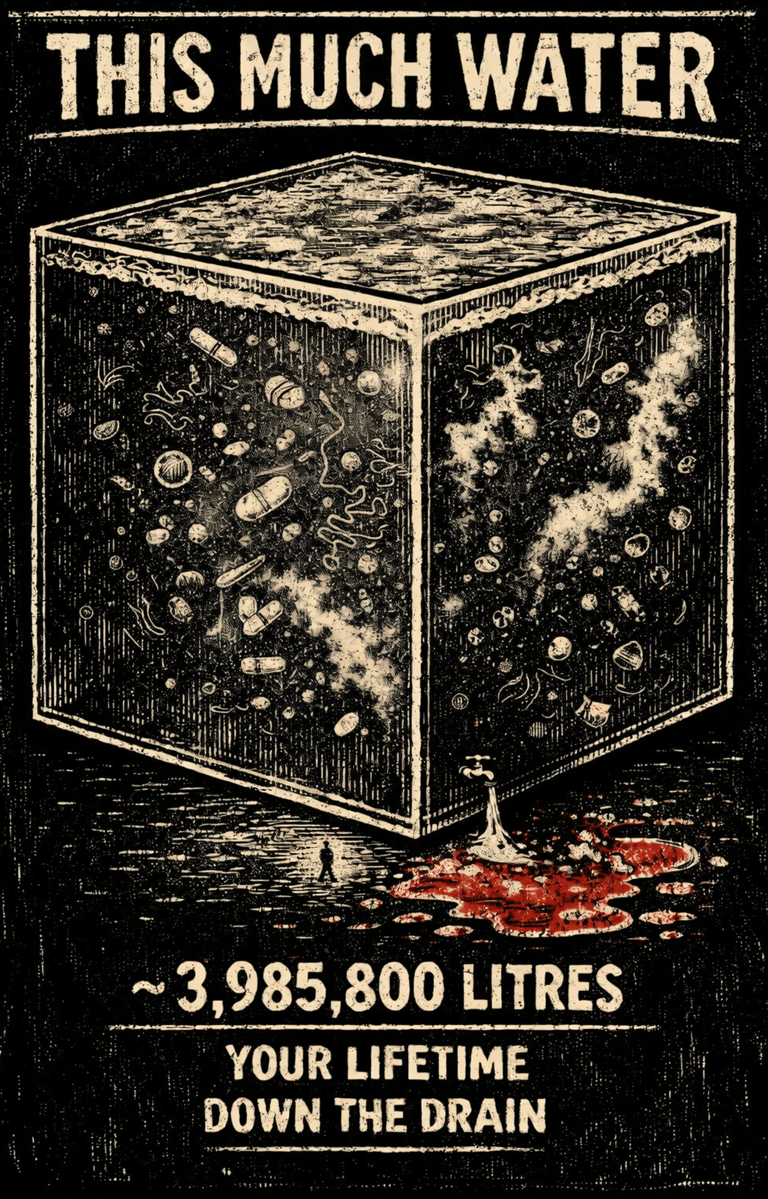
Think back to the last time you stood beside a clear stream. Water you could almost trust. Now imagine living a life where you quietly manufacture poison every day: over 80 years you run ~3,985,800 litres of household water through your home and back out as wastewater carrying detergents, microfibres, pharmaceuticals, and storm-overflow pulses. You rinse ~700 kg of personal-care chemistry down the drain. You burn ~373,300 kWh of gas for heat, pushing roughly ~27 kg of NOx and ~0.4 kg of fine particulates into the air. You grind your travel into dust; about ~8 kg of tyre particles and ~0.8 kg of brake dust washing into waterways (with far more settling into soils). You don’t have to intend harm for bodies to start failing downstream.
Wastewater and sewage pollution: what you flush becomes someone else’s river
~2 fish die downstream of your wastewater footprint; rarely in one cinematic disaster, more like chronic oxygen debt that occasionally tips into death.
~41,000 midge larvae die; bloodstream of silty rivers.
~15,000 mayfly nymphs die — the oxygen-sensitive ones that vanish first.
~13,000 caddisfly larvae die — case-builders erased when the water turns hostile.
~12,800 aquatic beetles die — predators and scavengers that run out of oxygen and prey.